
Starting August 17, 2026, Google will be making changes to its bidding systems, making it easier for you to get more consistent and predictable performance based on the targets you set, even when you make budget adjustments. Note: The Bid Target Adjustment Tool is now live and available in Google Ads.
This article explains the changes and the actions you can take to prepare. For additional information, visit Frequently asked questions about changes to Target-based bid strategies.
| A Google Ads update is coming for target-based bid strategies #googleads #digitalmarketing | How to fix your Google Ads bid targets in one click #googleads #googleadstips |
To view subtitles in your language, turn on YouTube captions. Select the Settings icon at the top right corner of the video player, select "Captions," and then specify your language.
On this page
- Overview of changes
- What you can expect from this update
- Next steps
- Options to keep or adjust your targets
Overview of changes
Today, when your campaign has a "Limited by budget" status, if you use a Target-based bid strategy (for example, Target CPA or Target ROAS), some campaigns may be overperforming on bidding targets and see performance fluctuations when budgets are adjusted.
After August 17, 2026, campaigns that are limited by budget that use a target-based bid strategy will more consistently perform toward your bid target, including when you make budget adjustments so you can grow your campaigns with more predictable performance.
What you can expect from this update
If you have a campaign that’s limited by budget that has historically overachieved its stated target, you may experience performance volatility if you don’t make any changes to the campaign before August 17.
Example
If your campaign's Target CPA is $10, but your recent actual CPA performance is $5, your campaign will deliver more closely to a $10 actual CPA starting August 17, 2026. Update your target to $5 to maintain your recent performance or to a target CPA of your choosing based on your business goals.
For multi-channel campaigns like Performance Max and Demand Gen, you may also see shifts in how traffic is distributed across different channels.
Because the system will optimize more consistently toward the target you entered, campaigns currently performing more efficiently than their set targets may see campaign performance trending toward your set target.
Eligibility
Note: App Campaigns, Video reach campaigns, and Video view campaigns (VVC) will continue using previous bidding behavior. Hotel and Display campaigns already have the new bidding behavior.
| Campaign type | |
| Search | |
| Shopping | |
| Performance Max | |
| Demand Gen | |
| Display | |
| Hotel | |
| Travel | |
| App campaigns | |
| Video reach campaigns | |
|
Video view campaigns (VVC) |
Platform availability
|
Google Ads |
|
|
Search Ads 360 |
|
|
Display & Video 360 |
|
|
Google Ads Editor |
|
|
Google Ads API |
Next steps
Google recommends that you review your campaigns that are "Limited by budget" and are using target-based bid strategies by August 17, 2026. Ensure your settings align with your business goals, especially for campaigns that are performing better than your targets. Google will not automatically adjust your bidding targets or budgets.
To help you review your campaigns, and update your bid targets, you can access the Target adjustment tool through two different areas in your Google Ads account:
Your account notifications
Use the following steps to access the Target Adjustment Tool from the notification in your account:
- Sign in to your Google Ads account.
- At the top of your account dashboard, find the notification banner with the headline that reads “Review your campaign targets.” You can also find the alert by clicking the Notifications icon
.
- Click Review campaigns. This will launch the standalone Bid Target Adjustment Tool.
The “Campaigns” page
Access the Target adjustment tool from the “Campaigns” page:
- Sign in to your Google Ads account.
- In your Google Ads account, click the Campaigns icon
.
- Click the Campaigns drop-down in the section menu.
- Click Campaigns.
- Next to the campaign whose target you’d like to update, click the Settings icon
.
- Select Bidding, and then click Review campaigns to open the Target Adjustment tool.
 .
.Within Search Ads 360
If your campaigns are managed via Search Ads 360, the tool will not appear in your Google Ads account. Instead, follow these steps:
- Log in to your Search Ads 360 account.
- Look for the account notifications banner and click Review bid strategies to open the target adjustment view.
If you want to maintain current performance for campaigns that are performing better than your targets, select “Apply” to update your targets based on the performance shown in the tool. If you're happy with your current bidding targets, no action is needed.
Additionally, you always have the option to increase your budget to confidently scale your campaigns and capture more volume at your stated targets.
Options to keep or adjust your targets
Depending on your goals, you can choose one of the following actions.
Keep your current target as it is
If your current campaign targets accurately reflect your business goals, no change to your bid target is required. Note that after August 17, if your campaigns were previously over-performing their targets, these campaigns will adjust their performance to deliver closer to your stated target. You can review these campaigns and adjust your targets manually in the new Bid Target Adjustment Tool, which is now available.
After August 17th, you can confidently scale your campaigns and capture more volume at your stated targets. Learn more about how to increase your budget.
Example
Your budget-constrained campaign has a Target CPA of $10, but it has been achieving a $5 CPA. You haven’t made any changes. Once the update takes effect, your campaign will start delivering closer to the $10 target you originally set.

Adjust your target in line with recent performance
If your campaign is performing better than your stated target and you want to maintain your current actual performance, select “Apply” in the Bid Target Adjustment Tool (available starting on July 6, 2026) to adjust your target based on your campaign's recent performance.
Example
Your campaign has a Target CPA of $10, but has been achieving a $5 CPA. You can lower your target to $5 in the Target Adjustment Tool. Your performance will stay close to $5, and you can raise your budget later.

Adjust your target to a custom number
You can enter a new target to match your business goals and focus on profitable conversions. Before and after the bidding change, you can continue to make target changes as business needs dictate.
Example
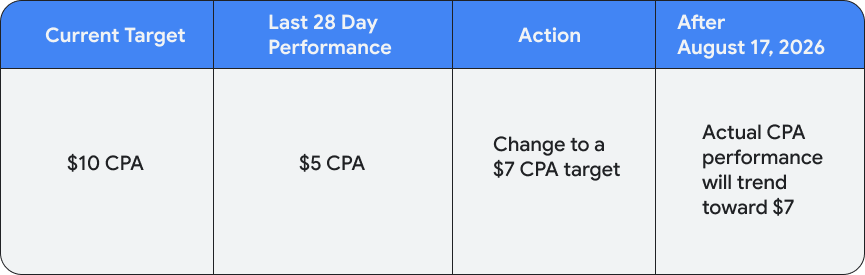
Your campaign has a Target CPA of $10, but has been achieving a $5 CPA. If $7 is the right target CPA for your campaign based on your business goals, you can lower your target to $7 in the Target Adjustment Tool. Your campaign’s performance will adjust to deliver closer to $7 after August 17, and any additional spend will scale closely to this target.
Change your bid strategy
Switching to these bid strategies can help maintain your conversion volume. However, because the Maximize Conversions and Maximize Conversion Value bid strategies optimize to spend your full budget without a target, your actual CPA or ROAS will fluctuate as you adjust your budget. Learn more about bid strategies to help you meet your goals.
Example
You can switch your campaign to a Maximize conversions or Maximize conversion value bid strategy to capture the highest volume of conversions or conversion value for your set budget.

Increase your budget
Prior to these changes, if you increased the daily budget on a "Limited by budget" campaign with an over performing Target-based bid strategy, you would likely see fluctuations or decreases in performance. After August 17, the changes to bidding strategies will help your campaigns consistently optimize to your stated target regardless of your budget limit. This means you can confidently increase your budget to capture more conversions and conversion value without your performance efficiency unexpectedly fluctuating.
With this update, consider taking the following actions:
- Give your budget room to scale: To capture as much profitable traffic as possible without restricting your campaign, try to maintain a daily budget that is comfortably higher than your average daily spend.
- Apply budget recommendations: Check your Recommendations page to forecast how many additional conversions you could gain at your target.
- Evaluate over time: After making budget increases, wait 1 to 2 conversion cycles to evaluate the campaign's performance to ensure it is delivering on your target.
